Running OSV-Scanner on this blog's own GitHub repository: the first command found nothing to scan, the second found 8 issues that mostly do not matter, and the library I most needed to fix never appeared in the report. How I set it up, how I fixed it, and where things stand.
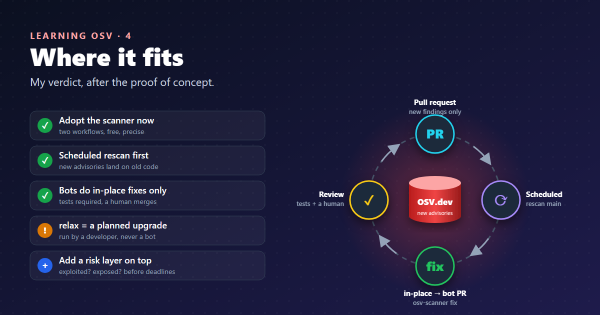
Closing the OSV proof of concept: where the database, the scanner and the fix command fit in a development pipeline, the two GitHub workflows to start with, what OSV does not do, and my recommendation.
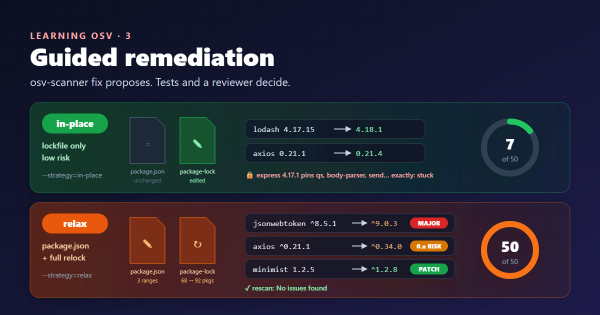
Proof of concept: let OSV-Scanner fix the vulnerable Node project. The safe in-place strategy fixed 7 of 50; the relax strategy fixed all 50 by changing three lines, two of them breaking upgrades. What each strategy does, why the numbers differ, and how to use it without getting burned.
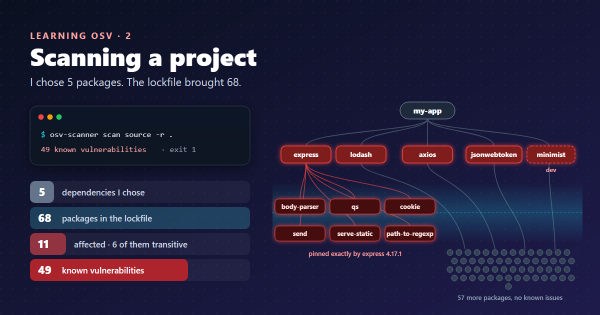
Proof of concept: install OSV-Scanner v2.7.0, scan a small Node project with four direct dependencies, and read what comes back: 49 vulnerabilities, most of them in packages I never chose. Plus exit codes, JSON output and an ignore file with an expiry date.
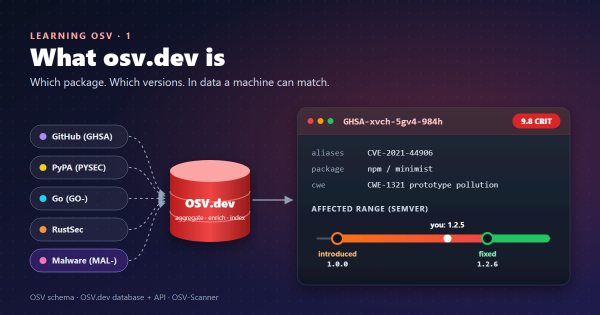
A proof-of-concept series on OSV, Google's open vulnerability database and scanner. Part 1: the problem OSV solves, how to navigate osv.dev, how to read a vulnerability record, and the one API call worth knowing.