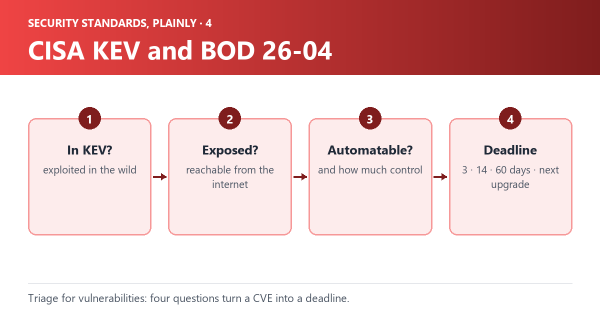
Every alert I read, including the Java4Shell one this week, leads with these four. In part 4 I wrote about deciding how fast to fix things. This part goes one step back: what the labels mean, who hands them out, and why the same bug can have two different scores.
Four names, four jobs#
| Answers | Run by | Looks like | |
|---|---|---|---|
| CVE | Which bug is this? | The CVE Program (MITRE, sponsored by CISA), with CNAs | CVE-2025-30065 |
| CWE | What kind of mistake caused it? | MITRE, sponsored by CISA | CWE-502 |
| NVD | What else do we know about it? | NIST, the US standards institute | a web page and an API for each CVE |
| CVSS | How bad is it, technically? | FIRST, a global forum of incident response teams | 9.8 Critical plus a vector string |
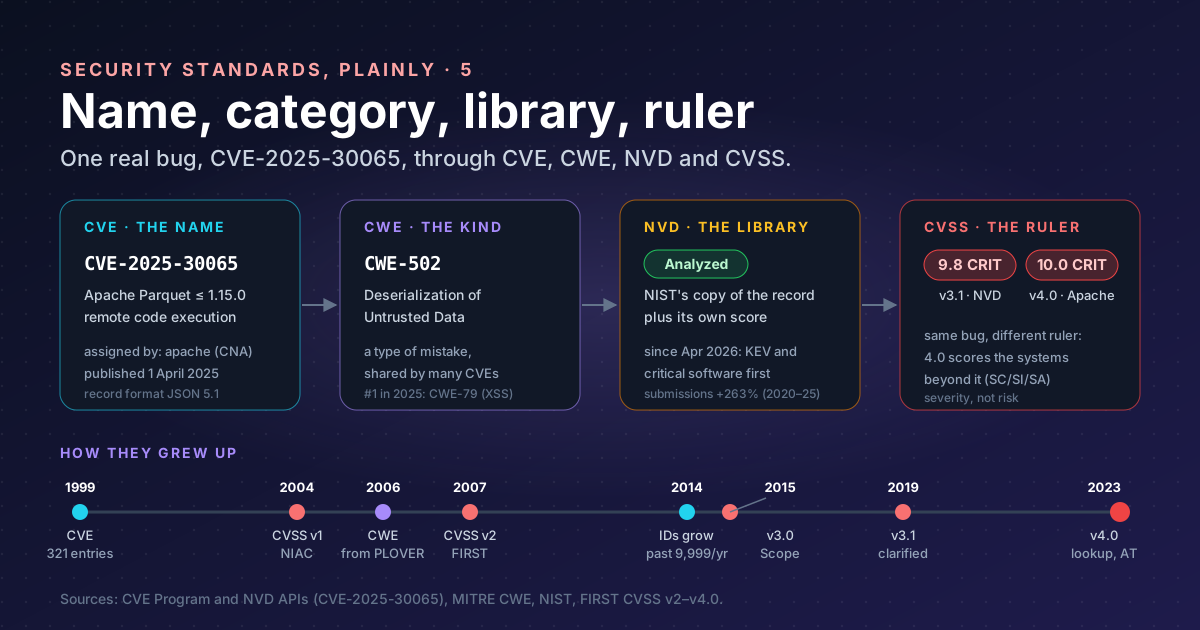
The easy way to keep them apart: CVE is a name, CWE is a category, NVD is a library, CVSS is a ruler.
CVE: one name for one bug#
Before 1999, every scanner and every database had its own name for the same hole, so nobody could tell if two reports were about the same thing. In January 1999, David Mann and Steven Christey of MITRE presented a paper, Towards a Common Enumeration of Vulnerabilities, at a workshop at Purdue. A working group created the first 321 entries, and the list was launched for the public in September 1999 (CVE history).
Two ideas from those days still matter:
- A CVE ID is just a name. It says nothing about severity. The format was
CVE-YYYY-NNNNuntil the four-digit limit, “a maximum of 9,999 unique identifiers per year”, became a problem. Since 1 January 2014 the number can be four digits or more (syntax change). That is why you now see IDs such asCVE-2026-114938. - IDs are handed out by CNAs, CVE Numbering Authorities. These are vendors, open-source foundations, CERTs and researchers that may assign IDs for their own products. Apache is one, so when a bug is found in an Apache project, Apache writes the record.
Today a CVE is more than a line in a list. It is a CVE record, a JSON document (format 5.1). The CNA’s part holds the description, the affected versions, often a CWE and a CVSS score. Others can add their own sections: CISA, for example, adds its exploitation assessment to many records.
The program nearly stopped in 2025. MITRE’s contract to run it was due to expire on 16 April 2025. CISA extended it the night before for 11 months, and CVE Board members announced a non-profit CVE Foundation as a fallback (The Register). Twenty-five years in, the whole industry’s vocabulary still hangs on one contract.
CWE: the kind of mistake#
A CVE is one instance: this bug in this version of this product. A CWE is the type of weakness behind it. CWE calls itself “a community-developed list of common software and hardware weaknesses” (About CWE).
It grew out of CVE. MITRE’s team had been sorting CVEs into rough groups. In 2005 that work became PLOVER, a document of more than 1,500 real examples in 290 weakness types, and in 2006 the first CWE list was published. Mobile content came in 2014 and hardware weaknesses in 2020 (CWE history).
Why it is useful to an engineer: CVEs tell you what to patch today, CWEs tell you what to stop writing. The 2025 CWE Top 25, built from 39,080 CVE records, opens with:
| Rank | CWE | Plain words |
|---|---|---|
| 1 | CWE-79 | Cross-site scripting: user input ends up as script in a page |
| 2 | CWE-89 | SQL injection: user input ends up as part of a query |
| 3 | CWE-352 | Cross-site request forgery: a site is tricked into acting for a logged-in user |
| 4 | CWE-862 | Missing authorisation: nobody checks if you are allowed |
| 5 | CWE-787 | Out-of-bounds write: writing past the end of a buffer |
(2025 list). Java4Shell, for instance, is CWE-122, a heap-based buffer overflow, a close cousin of number 5.
NVD: the library that adds the details#
The National Vulnerability Database is run by NIST and describes itself as “a repository of information on software and hardware flaws” (NIST). It copies every CVE record and, for the ones it gets to, adds enrichment: its own CVSS score, the list of affected product configurations, and links. Tools that say “data from NVD” mostly mean this enrichment.
“For the ones it gets to” is the important part. CVE submissions grew 263% between 2020 and 2025, and NIST could not keep up (NIST). In short:
- 2 April 2025: CVEs published before 2018 and still waiting were marked Deferred.
- 15 April 2026: enrichment became risk-based. CVEs in CISA’s KEV list, software used by federal agencies and critical software come first; the rest are “not scheduled for immediate enrichment”.
- Everything in the backlog published before 1 March 2026 moved to Not Scheduled.
- 17 June 2026: NVD started showing CISA’s SSVC decision data alongside CVSS.
The lesson for anyone building on NVD: an empty CVSS field does not mean “not serious”. It often means “not looked at yet”. Use the score the CNA put in the CVE record when NVD has none.
CVSS: a ruler that kept being redrawn#
The Common Vulnerability Scoring System turns a few questions about a bug into a number from 0.0 to 10.0. How it got here:
| Version | When | What changed, in one line |
|---|---|---|
| v1 | 2004 | Research for the US National Infrastructure Advisory Council (NIAC) (v2 guide) |
| v2 | June 2007 | Rewritten by FIRST’s CVSS group, which had been meeting since April 2005 (v2 history) |
| v3.0 | June 2015 | “Adapted for more modern concerns”: privileges, user interaction and Scope (SecurityWeek) |
| v3.1 | July 2019 | Clarifications and fixed formulas, “without introducing new metrics” (v3.1 user guide) |
| v4.0 | 1 November 2023 | New scoring method, Scope replaced, new metric groups (user guide) |
Along the way v3.0 was also adopted as an international standard, ITU-T X.1521, in March 2016.
Reading a vector#
The number matters less than the vector, the short string that says how the number was reached. Here is a 3.1 vector, the most common one you’ll see today:
CVSS:3.1/AV:N/AC:L/PR:N/UI:N/S:U/C:H/I:H/A:H = 9.8 Critical| Part | Means | Here |
|---|---|---|
AV:N | Attack vector | over the Network |
AC:L | Attack complexity | Low, no special conditions |
PR:N | Privileges required | None, no account |
UI:N | User interaction | None, nobody has to click |
S:U | Scope | Unchanged, the damage stays in the vulnerable component |
C:H/I:H/A:H | Confidentiality, integrity, availability | all High |
Read it as a sentence: “anyone on the network, with no account and no help, can fully take over this component”. The bands are the same in 3.1 and 4.0: Low 0.1–3.9, Medium 4.0–6.9, High 7.0–8.9, Critical 9.0–10.0 (v3.1 specification).
What 4.0 changed#
The 4.0 specification is the biggest change since 2007:
- Attack Requirements (
AT) is new. It splits “hard to attack” into the attacker’s own skill (AC) and outside conditions they can’t control, like winning a race (AT). - Scope is gone. Instead there are two sets of impact: on the vulnerable system (
VC/VI/VA) and on subsequent systems, everything else it can reach (SC/SI/SA). Scope was the part of 3.x people argued about most. - Temporal became Threat, and a Supplemental group adds information that doesn’t change the score, such as whether an attack can be automated.
- No more formula. Scores come from a lookup table built from expert rankings of grouped vectors (“MacroVectors”).
- Names say what was scored:
CVSS-B(base only),CVSS-BT(plus threat),CVSS-BE(plus your environment),CVSS-BTE(all three).
One bug, two rulers#
Here is a real record followed through all four systems: CVE-2025-30065, remote code execution in the
parquet-avro module of Apache Parquet 1.15.0 and earlier.
| System | What it says |
|---|---|
| CVE | Published 1 April 2025, assigned by apache (the CNA) |
| CWE | CWE-502, Deserialization of Untrusted Data: data is turned back into objects “without sufficiently ensuring that the resulting data will be valid” (CWE-502) |
| NVD | Status Analyzed; NIST added its own score |
| CVSS | 10.0 Critical in v4.0 from Apache; 9.8 Critical in v3.1 from NVD |
Same bug, same facts, different rulers. The 4.0 vector is
AV:N/AC:L/AT:N/PR:N/UI:N/VC:H/VI:H/VA:H/SC:H/SI:H/SA:H: Apache judged that systems beyond the library would be
hit too, so the subsequent-system impacts are high. That’s how one bug gets 10.0 from one scorer and 9.8 from the
other. Older bugs show the same effect between versions: NVD gave Log4Shell 9.3 under v2 and 10.0 under v3.1.
You can check it yourself. Both APIs are public, with no key for light use:
# The CVE record itself, as written by the CNA
curl -s https://cveawg.mitre.org/api/cve/CVE-2025-30065 | python3 -c "
import json, sys
r = json.load(sys.stdin); m = r['cveMetadata']; cna = r['containers']['cna']
print(m['cveId'], m['state'], 'assigned by', m['assignerShortName'])
print('CWE: ', cna['problemTypes'][0]['descriptions'][0]['description'])
for s in cna['metrics']:
    for k, v in s.items():
        if 'vectorString' in v: print(k, v['baseScore'], v['vectorString'])
"

# NVD's copy, with every score it holds and who gave it
curl -s "https://services.nvd.nist.gov/rest/json/cves/2.0?cveId=CVE-2025-30065" | python3 -c "
import json, sys
cve = json.load(sys.stdin)['vulnerabilities'][0]['cve']
print(cve['id'], cve['vulnStatus'])
for group in cve['metrics'].values():
    for s in group:
        if 'cvssData' in s:
            d = s['cvssData']; print(d['version'], d['baseScore'], d['baseSeverity'], 'from', s['source'])
"
CVE-2025-30065 PUBLISHED assigned by apache
CWE: CWE-502 Deserialization of Untrusted Data
cvssV4_0 10 CVSS:4.0/AV:N/AC:L/AT:N/PR:N/UI:N/VC:H/VI:H/VA:H/SC:H/SI:H/SA:H
CVE-2025-30065 Analyzed
4.0 10.0 CRITICAL from security@apache.org
3.1 9.8 CRITICAL from nvd@nist.govSeverity is not risk#
The thing I had to unlearn: a 9.8 is not “more urgent” than a 7.5 by itself. FIRST says so plainly: “CVSS is designed to measure the severity of a vulnerability and should not be used alone to assess risk” (v3.1 user guide). The 4.0 FAQ repeats it: base scores “are not risk, and should not be used alone for patch prioritization” (CVSS 4.0 FAQ).
CVSS tells you how bad the bug is in the worst case. Whether it is bad for you depends on things CVSS’s base score can’t know: is anyone exploiting it (KEV), how likely is that soon (EPSS), do you even run the affected part. That’s the triage from part 4.
Takeaways#
- CVE names one bug, CWE names the kind of mistake, NVD adds details, CVSS rates technical severity. Name, category, library, ruler.
- CVE IDs come from CNAs, often the vendor itself. The CVE record is the source; NVD is a copy with extras.
- NVD no longer enriches everything. An empty score means “not looked at yet”, so fall back to the CNA’s.
- CVSS has been redrawn four times. Always note the version: a 3.1 and a 4.0 score for the same bug can differ.
- Severity is not risk. Combine CVSS with exploitation data and your own exposure.
References#
- CVE history: CVE Program (archived site), the 1999 paper, the first 321 entries, the September 1999 launch
- CVE ID syntax change: CVE Program (archived site), the four-digit limit and the 2014 change
- CVE Services API: CVE-2025-30065: CVE Program, the record, its CNA, CWE and CVSS 4.0 score
- About CWE and CWE history: MITRE, the definition, sponsors, PLOVER and the 2006 first list
- 2025 CWE Top 25 and the full 2025 list: MITRE, the 39,080 records and the top five
- CWE-502: MITRE, Deserialization of Untrusted Data
- National Vulnerability Database: NIST, what NVD adds, the 263% growth, deferral and risk-based enrichment dates
- NVD API: CVE-2025-30065: NIST, NVD’s status and scores for the example (and for CVE-2021-44228, Log4Shell)
- CVSS v4.0 specification: FIRST, metric groups, Attack Requirements, subsequent systems, MacroVectors, CVSS-B/BT/BE/BTE
- CVSS v4.0 FAQ: FIRST, “not risk”, the new scoring method
- CVSS user guide: FIRST, the 1 November 2023 release of 4.0
- CVSS v3.1 specification: FIRST, base metrics, vector format, severity bands
- CVSS v3.1 user guide: FIRST, the changes from 3.0, ITU-T X.1521, severity versus risk
- CVSS v2 guide and CVSS v2 history: FIRST, the 2004 NIAC origin and the June 2007 release
- FIRST announces CVSS version 3.1: SecurityWeek, the July 2019 announcement and the June 2015 release of v3
- CVE program gets last-minute funding from CISA: The Register, the April 2025 contract scare and the CVE Foundation
Previous: part 4, CISA KEV and BOD 26-04. Start of the series: part 1, NIST SSDF.