When I started looking at Kafka security, I found myself jumping straight to configuration properties. That was backwards. I found it easier to ask three questions first:
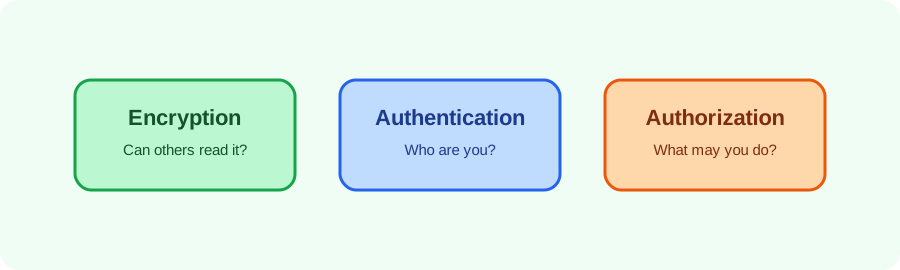
- Can the client prove who it is?
- Can the client communicate privately with the broker?
- Is that identity allowed to perform this operation?
These are authentication, encryption, and authorization. Configuring one does not automatically provide the others.
Encrypt the connection#
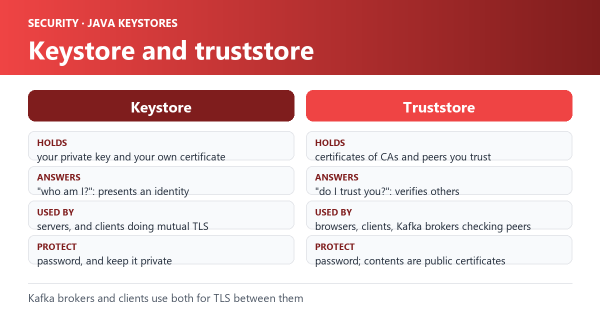
Use TLS for client-to-broker and broker-to-broker traffic where supported by the deployment. A broker listener should use a certificate whose name matches the address clients use. Keep private keys readable only by the Kafka service account.
Do not put real passwords or private keys in a playbook. Use a secret manager or an encrypted Ansible Vault file and provide placeholders in documentation:
ssl.keystore.password=<REPLACE-ME>
ssl.truststore.password=<REPLACE-ME>
Rotate certificates before expiry and monitor the complete chain, not only the leaf certificate.
Authenticate clients#
Common choices include mutual TLS, SASL/SCRAM, and SASL/OAUTHBEARER. Select one based on the identity system and Kafka client support you operate. Avoid sharing one credential across applications; separate identities make audit and revocation possible.
For a new client, document:
- the listener and protocol;
- the identity format;
- where credentials are stored;
- certificate or token rotation;
- the minimum permissions required.
Authorize operations#
Authentication says who a client is. Kafka authorization decides whether that identity can read, write, create, or alter a resource. Grant access to named topics and consumer groups rather than broad cluster permissions.
A useful design is to give a producer write access only to its topic and a consumer read access only to its topic and group. Administrative operations should use separate identities.
Operational controls#
Security also includes the surrounding system:
- restrict broker listeners with network controls;
- keep inter-broker credentials separate from application credentials;
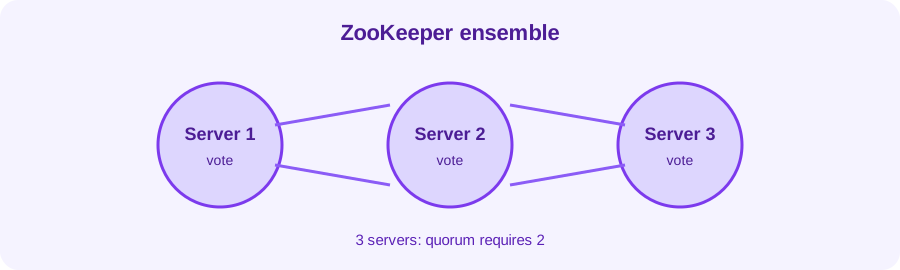
- protect ZooKeeper or use the supported KRaft security model;
- audit authentication failures and authorization denials;
- avoid logging tokens, passwords, or full connection headers;
- test revocation and certificate rotation before an incident.
Test the negative path#
A secure configuration is not proven by a successful connection. Test that an unauthenticated client is rejected, an authenticated client without permission is denied, and an authorized client can perform only the intended operation.
Security is a set of explicit boundaries. Documenting those boundaries makes Kafka easier to operate than relying on a single setting named security.
Illustrative negative-path test:
ProducerRecordException:
  TopicAuthorizationException: Not authorized to access topics: [events]
Expected result: application identity rejected until WRITE permission is granted.