
↓ Skip to main content
Python

Python vs Bash

·1 min
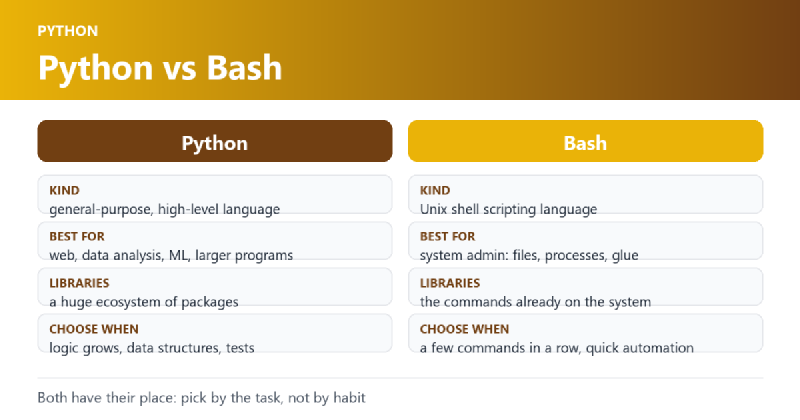
Python compared with Bash: kind of language, what each is best for, libraries, and when to choose each
Recreated in October 2026 from the post; the original image was lost

Python and bash are both programming languages, but they have different purposes and use cases.

Python is a general-purpose, high-level programming language that is used for a wide range of tasks, including web development, data analysis, machine learning, and scientific computing. It is known for its readability and simplicity, making it easy for new programmers to learn.

Bash, on the other hand, is a Unix shell scripting language that is typically used for system administration and automation tasks, such as managing files and directories, executing commands, and manipulating text files. Bash scripts are commonly used in combination with other Unix tools, such as sed and awk, to perform complex tasks.

In terms of functionality, Python provides many more libraries and frameworks compared to bash, which makes it a more suitable choice for more complex programming tasks. On the other hand, bash is more flexible and faster in performing certain tasks that are specific to Unix systems.

Overall, both languages have their strengths and weaknesses, and the choice between them depends on the specific requirements of the task at hand.

Author
Samarthya
Engineer, learner, tinkerer. This is my trophy shelf of everyday work and leisure.

Related

Bash: Named Reference

Bash is different world. Powerful, simple, elegant and complex all at the same time. Recently while trying to reduce the burden of repetitive code, I was trying to check what can be done to use references in Bash (something like pointers) and it was an interesting problem that I enjoyed solving.

Notes: For self

·1 min
bash = & == Brackets [ bc awk Bash is a string oriented language We do not write step=$((step++)) this expression will return a numeric value which the shell will then take as the command to to be executed. No spaces are allowed around the equal sign for variable assignment. let "step++" is same as (( step++ )) Use declare to set variable values and attributes In bash = and == both mean the same thing 💬 What is the difference between [ and [[? • if cd $dir; then In this case the command cd $dir will be executed and based on success or failure of the command executed the if or else part will be executed respectively. if [$dir]; then <span class="absolute top-0 w-6 transition-opacity opacity-0 -start-6 not-prose group-hover:opacity-100 select-none"> <a class="text-primary-300 dark:text-neutral-700 !no-underline" href="#if-dir-then" aria-label="Anchor">#</a> </span> Single bracket is equivalent to test command evaluate conditional expression • < & > Within [ compare using simple ASCII ordering & within [[ comparison is lexicographic. Within [ you have to escape \> to avoid redirection. 💬 BC is a language?

Python: Polymorphism

·2 mins
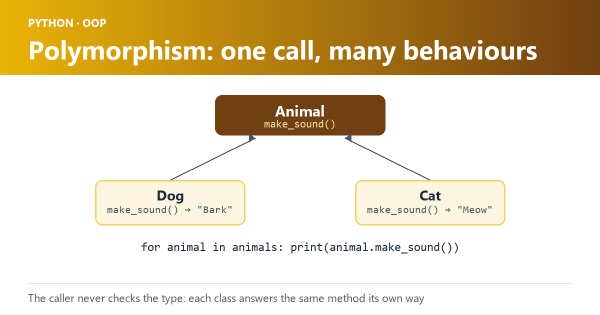
Recreated in October 2026 from the post; the original image was lost Polymorphism is a key feature of Object Oriented Programming that allows objects of different classes to be treated as objects of a common class. It is done by implementing the same methods across all classes and making use of inheritance, interfaces and overloading.