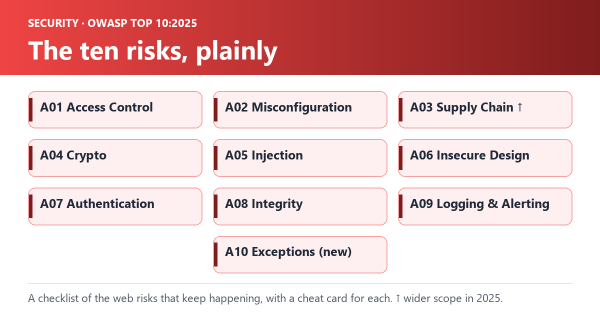
The OWASP Top 10 describes weaknesses in your software.
ATT&CK describes what attackers do: how they get in, stay in, move around and take what they came for. You
will see its IDs, such as T1190 or T1552.001, in threat reports, detection rules and, increasingly, in
pipeline designs like the one in my
SSDLC post. This post explains how to read them.
What it is#
MITRE’s own definition is short: ATT&CK is a “knowledge base of adversarial techniques based on real-world observations” (ATT&CK resources). It is free to use, and every entry links to the public reports it was built from.
There are three matrices: Enterprise (Windows, Linux, macOS, cloud, containers, network devices), Mobile and ICS (industrial control systems). This post covers Enterprise.
The current release is ATT&CK v20, from 13 October 2026. Its Enterprise matrix has 15 tactics, 227 techniques and 479 sub-techniques (ATT&CK updates).
How to read an ID#
ATT&CK has a small vocabulary. MITRE puts it this way: tactics are the why, techniques are the how.
| Prefix | Is a… | Example | Answers |
|---|---|---|---|
TA | Tactic: the attacker’s goal at this step | TA0001 Initial Access | Why are they doing this? |
T | Technique: a way to reach that goal | T1552 Unsecured Credentials | How, in general? |
T….nnn | Sub-technique: a more specific way | T1552.001 Credentials In Files | How, exactly? |
M | Mitigation: a defence that helps | M1047 Audit | What stops it? |
G, S | Group and Software: who uses it, with which tools | Who has done it? |
So T1552.001 reads as: technique 1552, Unsecured Credentials, sub-technique 001, Credentials In Files
(T1552.001). It falls under the Credential Access tactic, and
MITRE lists mitigations such as auditing for password files (M1047) and password policies that forbid storing
them (M1027). That is a leaked .env file in a repository, described in a way every security tool understands.
One technique can serve several tactics. T1078 Valid Accounts, logging in with stolen but real credentials,
is listed under Initial Access, Persistence, Privilege Escalation and Stealth, because a real account helps with
all four.
What changed recently: Defense Evasion was split#
If you learned ATT&CK a few years ago, you will remember 14 tactics, including Defense Evasion. That tactic is gone. In its place are two (Sophos):
- Stealth (
TA0005, the old ID): “The adversary is trying to hide and conceal their actions, appearing as normal behavior”, for example Masquerading (T1036) or Obfuscated Files or Information (T1027) (TA0005). - Defense Impairment (
TA0112, new, created in April 2026): “The adversary is trying to break security mechanisms, pipelines, and tooling so defenders can’t see or trust what’s happening”, for example Disable or Modify Tools (T1685) (TA0112).
The difference is useful: hiding from your defences versus breaking them. Note the word “pipelines” in the new tactic. Tampering with a CI system’s security checks is now a named attacker goal. Older reports and tools still use Defense Evasion; map them to one of the two.
The cheat cards: 15 tactics#
One card per tactic, in the order an attack usually unfolds. Each has the tactic ID, its goal in plain words, one example technique and what a development team can do about it. The colours group the phases: blue for getting in, orange for gaining a foothold, purple for spreading, red for the payoff.
Reconnaissance
Goal: learn about the target.
Example: T1595 Active Scanning of your public hosts.
Dev angle: expose less; no version banners or debug endpoints.
Resource Development
Goal: prepare tools and infrastructure.
Example: T1583 Acquire Infrastructure, such as look-alike domains.
Dev angle: mostly outside your control; watch for typo-squatted packages.
Initial Access
Goal: get a first foothold.
Example: T1190 Exploit Public-Facing Application; T1195 Supply Chain Compromise.
Dev angle: patch exposed services first; scan dependencies.
Execution
Goal: run their code.
Example: T1059 Command and Scripting Interpreter.
Dev angle: never pass user input to a shell; parameterise.
Persistence
Goal: stay in after a restart or a password change.
Example: T1053 Scheduled Task/Job.
Dev angle: immutable images; rebuild rather than patch in place.
Privilege Escalation
Goal: get more rights than they started with.
Example: T1068 Exploitation for Privilege Escalation.
Dev angle: run as non-root; least-privilege service accounts.
Stealth
Goal: hide, and look like normal activity.
Example: T1036 Masquerading as a legitimate binary.
Dev angle: signed artifacts; know what normal looks like.
Defense Impairment
Goal: break the defences, including pipelines.
Example: T1685 Disable or Modify Tools.
Dev angle: protect CI config; alert when a security check is removed.
Credential Access
Goal: steal account names and passwords.
Example: T1552.001 Credentials In Files.
Dev angle: secret scanning on every commit; a secrets manager.
Discovery
Goal: learn the environment from inside.
Example: T1082 System Information Discovery.
Dev angle: minimal images with no extra tools to explore with.
Lateral Movement
Goal: move to other systems.
Example: T1021 Remote Services.
Dev angle: network policies; no shared credentials between services.
Collection
Goal: gather the data they want.
Example: T1213 Data from Information Repositories, such as wikis and code hosts.
Dev angle: access reviews; nothing secret in tickets or wikis.
Command and Control
Goal: talk to compromised systems.
Example: T1071 Application Layer Protocol, hiding in normal web traffic.
Dev angle: restrict outbound traffic from workloads.
Exfiltration
Goal: get the data out.
Example: T1041 Exfiltration Over C2 Channel.
Dev angle: egress limits; alert on unusual data volumes.
Impact
Goal: disrupt, destroy or hold to ransom.
Example: T1486 Data Encrypted for Impact (ransomware).
Dev angle: tested backups; infrastructure you can rebuild from code.
How a developer uses it#
ATT&CK was built for defenders and threat hunters, but it is useful one step earlier, in the pipeline.
Name what each control stops. “Gitleaks on commit” is a tool. “Gitleaks on commit stops
T1552.001” is a reason. The SSDLC post tags every pipeline level this way:Pipeline level Technique it guards against MITRE mitigation Commit: secret scanning T1552.001Credentials In FilesM1047 Audit PR and build: dependency scanning T1195.001Compromise Software Dependencies and Development ToolsM1016 Vulnerability Scanning Build: signed provenance T1195.002Compromise Software Supply ChainM1013 Application Developer Guidance Nightly rescan of exposed apps T1190Exploit Public-Facing ApplicationM1051 Update Software Techniques from T1195 and T1190; mitigations as MITRE lists them.
Find the gaps. Shade the techniques you cover in the free ATT&CK Navigator. The white areas are the conversation for your next planning meeting.
Speak the same language as the security team. A finding tagged with an OWASP category (the weakness) and an ATT&CK technique (the attack) is understood by developers and by the people who write detections.
What it does not do#
- It does not rank anything. ATT&CK does not say which technique is most dangerous for you. Use exposure, KEV and EPSS for that, as in part 4 of the standards series.
- It is not a checklist to complete. Hundreds of techniques, many irrelevant to a given system. Pick the ones your architecture makes possible.
- IDs change. Techniques get added, moved and occasionally replaced; in 2026 even a tactic was split. Note the version when you tag findings.
Takeaways#
- ATT&CK is match footage of real attackers: tactics are the why (
TA…), techniques the how (T…), sub-techniques the exact how (T….001). - v20 (13 October 2026): 15 Enterprise tactics, 227 techniques, 479 sub-techniques. Defense Evasion became Stealth and Defense Impairment.
- For developers, the value is naming what each control stops and spotting what nothing stops.
- OWASP Top 10 describes the weakness; ATT&CK describes the attack. Use both.
References#
- MITRE ATT&CK: MITRE, the three matrices and the Enterprise tactic list with IDs
- ATT&CK updates: MITRE, v20 release date (13 October 2026) and Enterprise counts
- ATT&CK resources: MITRE, the definition, tactics as “why” and techniques as “how”, ATT&CK Navigator
- TA0005 Stealth and TA0112 Defense Impairment: MITRE, descriptions, creation date, example techniques
- T1552.001 Credentials In Files: MITRE, description and mitigations M1047, M1027
- T1195 Supply Chain Compromise: MITRE, sub-techniques .001 to .003 and mitigations
- T1190 Exploit Public-Facing Application: MITRE, tactic, description, mitigations M1051, M1035, M1030, M1050
- Technique pages used for the cheat cards: T1595, T1583, T1059, T1053, T1068, T1036, T1685, T1082, T1021, T1213, T1071, T1041, T1486, T1078: MITRE, names and tactics as of v20
- MITRE Enterprise ATT&CK grew a 15th tactic: Sophos, that Stealth and Defense Impairment replaced Defense Evasion