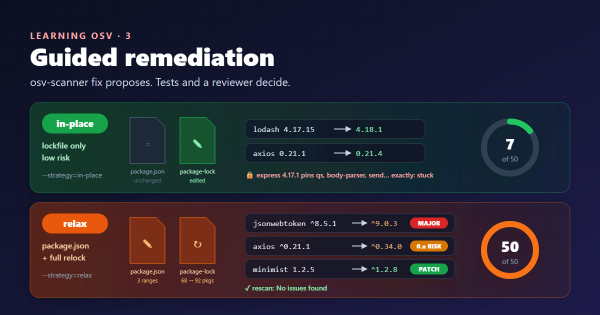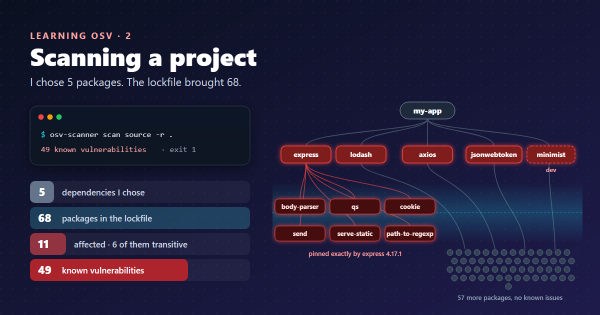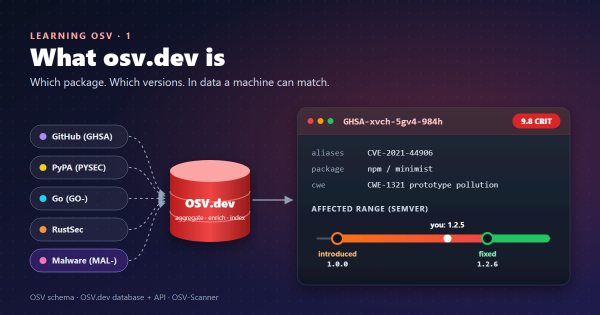
Quick recap of the proof of concept: part 1 read the database, part 2 scanned a project (5 dependencies, 68 packages, 49 vulnerabilities), and part 3 fixed it (7 of 50 safely, 50 of 50 with a major upgrade).
Where each piece fits#
flowchart LR
  PR["Pull request
scan the diff"] --> M["Merge to main
full scan + SARIF"]
  M --> N["Weekly / nightly
rescan main"]
  N --> F["Findings
osv-scanner fix
in-place → bot PR"]
  F --> R["Human review
tests + merge"]
  R --> PR
  DB[("OSV.dev
updated continuously")] -.-> PR
  DB -.-> N
| Stage | OSV piece | Why |
|---|---|---|
| Pull request | Scanner, PR mode | Shows only what this change adds, while the author still has context |
| Main branch, on a schedule | Scanner, full mode | New advisories arrive for code nobody touched |
| Remediation | fix --strategy=in-place | Safe, lockfile-only changes a bot can propose |
| Bigger upgrades | fix --strategy=relax | Run by a person, with the test suite |
| Investigation | osv.dev and its API | Aliases, ranges and fixed versions for one finding |
Start with two workflows#
The OSV-Scanner GitHub Action provides two reusable workflows. The PR workflow reports only vulnerabilities the pull request introduces; the scheduled one reports everything and uploads SARIF to the Security tab.
# .github/workflows/osv-scanner-pr.yml
name: OSV-Scanner PR Scan
on:
  pull_request:
    branches: [main]
permissions:
  actions: read
  security-events: write
  contents: read
jobs:
  scan-pr:
    uses: "google/osv-scanner-action/.github/workflows/osv-scanner-reusable-pr.yml@v2.7.0"
# .github/workflows/osv-scanner-scheduled.yml
name: OSV-Scanner Scheduled Scan
on:
schedule:
- cron: "30 12 * * 1"
push:
branches: [main]
permissions:
actions: read
security-events: write
contents: read
jobs:
scan-scheduled:
uses: "google/osv-scanner-action/.github/workflows/osv-scanner-reusable.yml@v2.7.0"By default the PR workflow only warns. I would keep it that way for a few weeks, fix the backlog, then make it blocking.
What it does well#
- Precise matching. Ecosystem-native version ranges mean few “maybe affected” findings.
- Breadth. Language packages, OS packages, GitHub Actions, and
MAL-records for known malware. - Free and open. Open-source code, a public database, an API, and a downloadable dataset for offline use (offline mode).
- Built for pipelines. Clear exit codes, JSON and SARIF, and an ignore file with reasons and expiry dates.
- A fix proposal, not just a list. Even the small in-place win is work a person no longer has to do.
What it does not do (yet)#
- It does not prioritise by risk. CVSS is there; whether a CVE is being exploited (CISA KEV) or likely to be (EPSS) is not. Join those yourself.
- Remediation is narrow and experimental. npm and Maven only; no Python, Go or containers in
fixtoday. - It finds known issues in dependencies. Not your own code (that is SAST), not secrets, not misconfiguration.
- Reachability is partial. Call analysis exists, on by default for Go only; for the rest, “affected” means “present”, not “exploitable”.
My recommendation#
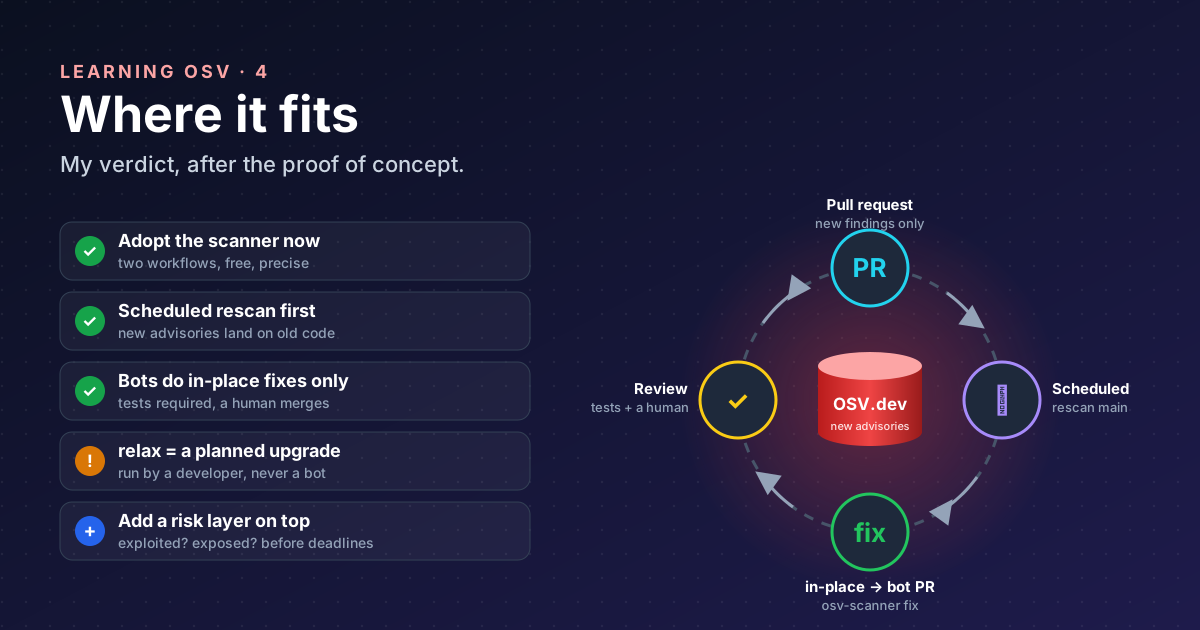
- Adopt the scanner now. Add the two workflows; it costs nothing and the signal is precise.
- Make the scheduled scan the priority, not the PR scan. New advisories land on old code; that is where the surprises are.
- Automate only in-place fixes as bot pull requests, with tests required and a human approving the merge.
- Treat
relaxas a planned upgrade, run by a developer, never by a bot. - Keep accepted risks in
osv-scanner.toml, each with a reason and anignoreUntildate, reviewed like code. - Add a risk layer on top (exploitation and exposure) before you let findings set deadlines.
Conclusion#
OSV is the most precise free answer I have found to “which of my dependencies are vulnerable, and to what version do I move?”. The database is the real asset; the scanner makes it usable in a pipeline; the fix command is a promising, honest helper that shows its trade-offs instead of hiding them. It does not replace judgement about what matters first, and it does not cover your own code. As one layer of a secure development life cycle, it earns its place on day one.
References#
- GitHub Action: OSV-Scanner docs, the two reusable workflows, permissions, PR mode warn-only default, SARIF upload
- Offline mode: OSV-Scanner docs, scanning without network access
- Guided remediation: OSV-Scanner docs, supported ecosystems and experimental status
- Project source scanning: OSV-Scanner docs, call analysis defaults
- OSV-Scanner: OSV-Scanner docs, overview