osv-scanner fix tries to do.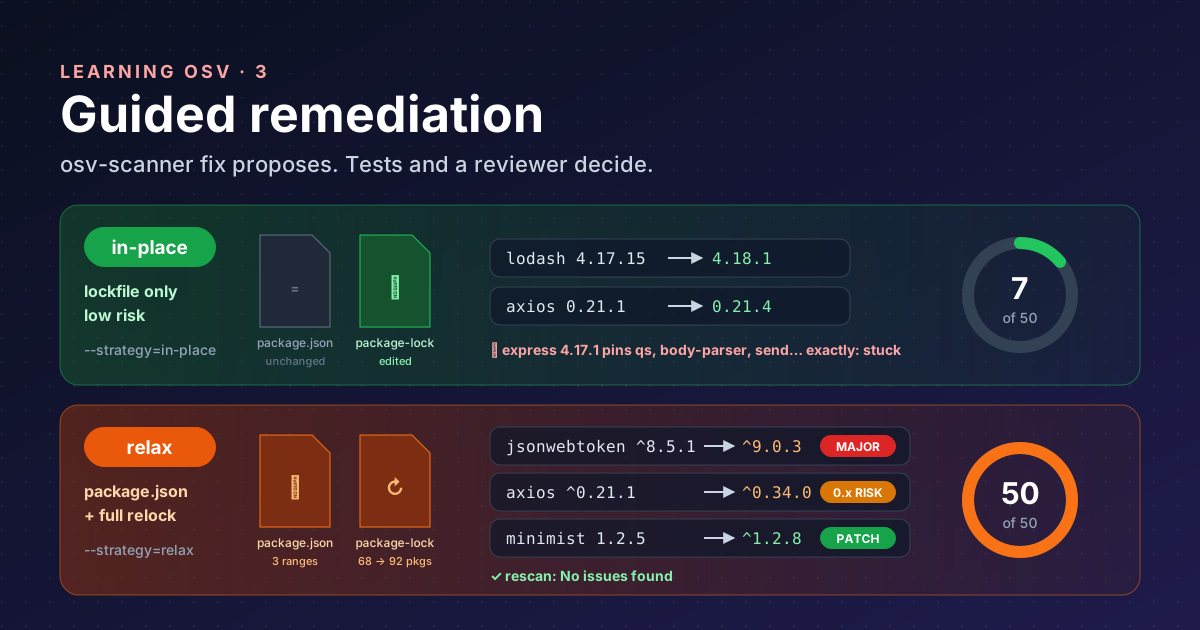
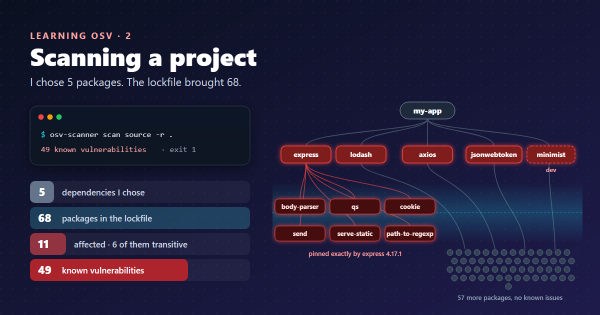
In part 2 the scanner found 49 known vulnerabilities in a small Node project. This part tries the guided remediation command on it.
What it is#
osv-scanner fix proposes “a small set of concrete changes” to your manifest and lockfile, and can apply them
(guided remediation docs). It is listed
as experimental. Today it supports:
| File | Strategy | What it changes |
|---|---|---|
package-lock.json | in-place | Only the lockfile: swaps vulnerable versions for safe ones that still satisfy existing ranges |
package.json | relax | Raises ranges in package.json where needed, then relocks the whole tree |
pom.xml | override | Maven: adds versions to <dependencyManagement> and bumps direct dependencies |
It prints a warning first, and it is worth repeating: on an untrusted project, the package manager may run scripts or contact registries the project names. Run it only on code you trust.
Strategy 1: in-place (low risk)#
osv-scanner fix --strategy=in-place -L package-lock.jsonFound 50 vulnerabilities matching the filter
Can fix 7/50 matching vulnerabilities by changing 2 dependencies
UPGRADED-PACKAGE: lodash,4.17.15,4.18.1
UPGRADED-PACKAGE: axios,0.21.1,0.21.4
REMAINING-VULNS: 43(The fix command counts 50; the scan showed 49 rows because two IDs for one path-to-regexp issue share a row.)
Only 7. package.json did not change at all. lodash and axios could move inside their caret ranges. Express
could not help, and the reason is instructive: Express 4.17.1 pins its own dependencies to exact versions
(qs 6.7.0, body-parser 1.19.0, …). No lockfile edit can move a package its parent has pinned exactly. The
fix has to come from a newer Express.
Strategy 2: relax (fixes more, may break things)#
osv-scanner fix --strategy=relax -M package.json -L package-lock.jsonCan fix 50/50 matching vulnerabilities by changing 3 dependencies
UPGRADED-PACKAGE: axios,^0.21.1,^0.34.0
UPGRADED-PACKAGE: jsonwebtoken,^8.5.1,^9.0.3
UPGRADED-PACKAGE: minimist,1.2.5,^1.2.8
REMAINING-VULNS: 0Three lines changed, all 50 gone. Express’s range did not even change: relocking resolved Express 4.22.3, the newest 4.x, which brings fixed versions of everything it pins. But read the three upgrades carefully:
| Change | Risk |
|---|---|
jsonwebtoken 8 → 9 | Major version: breaking changes by definition |
axios 0.21 → 0.34 | Under 0.x versioning, a minor bump can break things too |
minimist 1.2.5 → ^1.2.8 | Patch-level; safe |
A rescan proves the result:
Scanned ./package-lock.json file and found 92 packages
No issues found
Note the package count: 68 became 92. A relock reshapes the tree; newer versions bring new dependencies.
Keeping it under control#
The flags I would use in practice (docs):
| Flag | Use |
|---|---|
--upgrade-config=minor | Never propose a major upgrade; can be set per package |
--max-depth=1 | Only vulnerabilities in direct dependencies |
--min-severity=7 | Ignore findings below a CVSS score |
--ignore-dev | Skip devDependencies |
--no-introduce | Reject patches that would add new vulnerabilities |
--apply-top=N | Apply only the N best patches |
--format=json | Output for a bot to turn into a pull request |
And three caveats from the docs to keep in mind:
- It edits your files. Commit first.
- It does not reinstall
node_modules. Runnpm ciand your tests afterwards. - It does not read
osv-scanner.toml; pass accepted risks with--ignore-vulns.
What I took from this part#
- in-place is a safe, small win (7 of 50 here): lockfile-only, no new ranges. Good for automatic PRs.
- relax gets everything (50 of 50) but chose a major upgrade. That needs a human and the test suite.
- Pinned transitive dependencies are why lockfile fixes stall: the fix is to upgrade the parent.
- The tool proposes; the test suite and a reviewer decide.
References#
- Guided remediation: OSV-Scanner docs, supported files, strategies, flags, risks and limitations
- OSV-Scanner releases: GitHub, v2.7.0 used for these runs
Previous: part 2. Next: part 4, my recommendation.