package.json.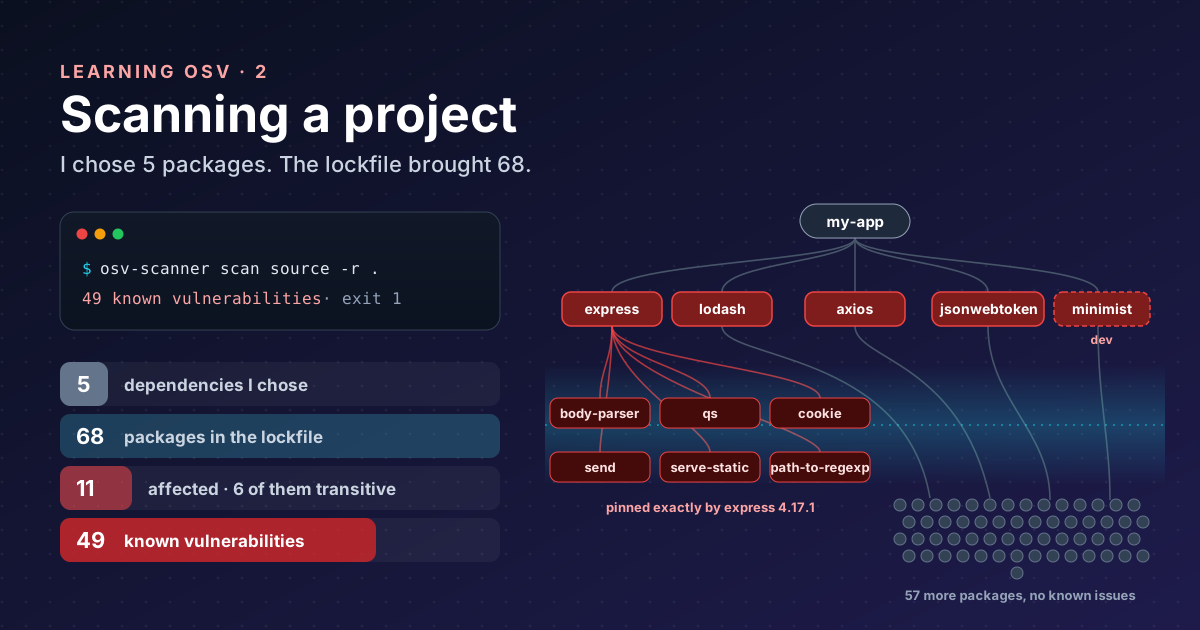
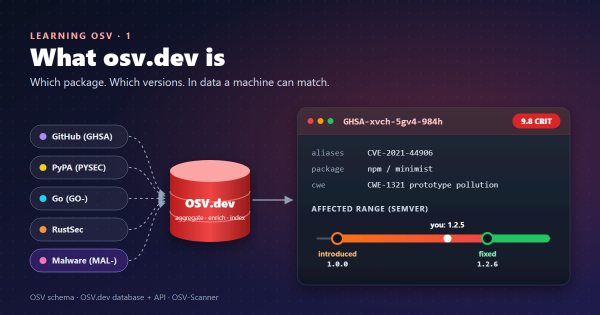
Part 1 was about the OSV database. This part runs the scanner against a small project and reads the result.
Install, and check what you installed#
OSV-Scanner is a single binary. I downloaded v2.7.0 (12 October 2026) from the releases page and checked it against the published checksums before running it. It is a security tool; treat its supply chain like one.
gh release download v2.7.0 -R google/osv-scanner \
  -p "osv-scanner_linux_amd64" -p "osv-scanner_SHA256SUMS"
sha256sum -c --ignore-missing osv-scanner_SHA256SUMS
chmod +x osv-scanner_linux_amd64 && mv osv-scanner_linux_amd64 osv-scanner
./osv-scanner --version     # osv-scanner version: 2.7.0
Other options are on the installation page.
The test project#
A deliberately old Node app, my-app: four runtime dependencies and one dev dependency. I generated only the
lockfile, with npm install --package-lock-only --ignore-scripts, so no package code ran on my machine.
{
  "dependencies": {
    "express": "^4.17.1",
    "lodash": "^4.17.15",
    "axios": "^0.21.1",
    "jsonwebtoken": "^8.5.1"
  },
  "devDependencies": { "minimist": "1.2.5" }
}
The lockfile resolves these five to 68 packages.
The scan#
osv-scanner scan source -r .scan source looks for lockfiles, SBOMs and git submodules; -r goes into subdirectories
(scan source docs). The result, trimmed:
Scanned ./package-lock.json file and found 68 packages

Total 11 packages affected by 49 known vulnerabilities
(1 Critical, 21 High, 23 Medium, 3 Low, 1 Unknown) from 1 ecosystem.
49 vulnerabilities can be fixed.

| OSV URL                             | CVSS | PACKAGE        | VERSION | FIXED VERSION |
|-------------------------------------|------|----------------|---------|---------------|
| https://osv.dev/GHSA-cph5-m8f7-6c5x | 7.5  | axios          | 0.21.1  | 0.21.2        |
| https://osv.dev/GHSA-27r3-jxmh-p828 | 7.5  | body-parser    | 1.19.0  | 1.20.9        |
| https://osv.dev/GHSA-8cf7-32gw-wr33 | 8.1  | jsonwebtoken   | 8.5.1   | 9.0.0         |
| https://osv.dev/GHSA-35jh-r3h4-6jhm | 7.2  | lodash         | 4.17.15 | 4.17.21       |
| https://osv.dev/GHSA-xvch-5gv4-984h | 9.8  | minimist (dev) | 1.2.5   | 1.2.6         |
| https://osv.dev/GHSA-37ch-88jc-xwx2 | 7.7  | path-to-regexp | 0.1.7   | 0.1.13        |
| https://osv.dev/GHSA-hrpp-h998-j3pp | 7.5  | qs             | 6.7.0   | 6.7.3         |
| ...                                 |      |                |         |               |
How to read it#
- Most findings are transitive.
body-parser,qs,path-to-regexp,send,serve-staticandcookieare not in mypackage.json. They come with Express. Six of the eleven affected packages are ones I never chose. - One package, many rows. axios 0.21.1 alone has 24 entries. Count packages to fix, not rows.
(dev)is marked. The only Critical is in a dev dependency. That changes its priority, but it does not make it zero: dev tools run in CI, with access to secrets.- FIXED VERSION is the target, taken from the record’s
fixedevent, as in part 1. - Every row links to osv.dev, so the next click is the record.
Exit codes: 1 means findings, 0 means none (output docs).
One more is worth knowing for CI: 128 means no packages were found. A job that scans the wrong directory
should fail loudly, not pass quietly, so treat 128 as an error.
Machine-readable output#
--format json gives one entry per package with its vulnerabilities grouped by alias, which is handy for a
findings store:
{ "ids": ["GHSA-3g43-6gmg-66jw"], "aliases": ["CVE-2026-44495", "GHSA-3g43-6gmg-66jw"], "max_severity": "7.0" }Other formats include sarif for GitHub code scanning, markdown for PR comments, html, and SBOM formats
(spdx-2-3, cyclonedx-1-5).
Accepting a risk, on the record#
Sometimes the right answer is “not now”. OSV-Scanner reads an osv-scanner.toml next to the lockfile
(configuration docs):
[[IgnoredVulns]]
id = "GHSA-xvch-5gv4-984h"
ignoreUntil = 2026-12-31
reason = "minimist is a devDependency used only by a local build script; not shipped"
The scanner then says so, out loud:
GHSA-xvch-5gv4-984h and 1 alias have been filtered out because: minimist is a devDependency used only by a local build script; not shipped
Filtered 1 vulnerability from output
Total 10 packages affected by 48 known vulnerabilities (0 Critical, ...)
Two details I like: ignoring an ID also ignores its aliases, so the CVE does not sneak back in under another name;
and ignoreUntil makes the exception expire, so a “temporary” decision cannot become permanent by accident.
What I took from this part#
- Scan the lockfile: 5 dependencies became 68 packages and 11 affected ones.
- Read by package, not by row, and look at the fixed version first.
- Exit code 1/0 is enough for a CI gate; treat 128 (nothing scanned) as a failure.
- Every accepted risk gets a reason and an expiry date, in a file reviewed like code.
References#
- OSV-Scanner releases: GitHub, v2.7.0 binary and SHA256SUMS
- Installation: OSV-Scanner docs
- Project source scanning: OSV-Scanner docs,
scan source,-r, what is detected - Output: OSV-Scanner docs, output formats and exit codes
- Configuration: OSV-Scanner docs,
osv-scanner.toml,IgnoredVulns,ignoreUntil, aliases
Previous: part 1. Next: part 3, guided remediation.