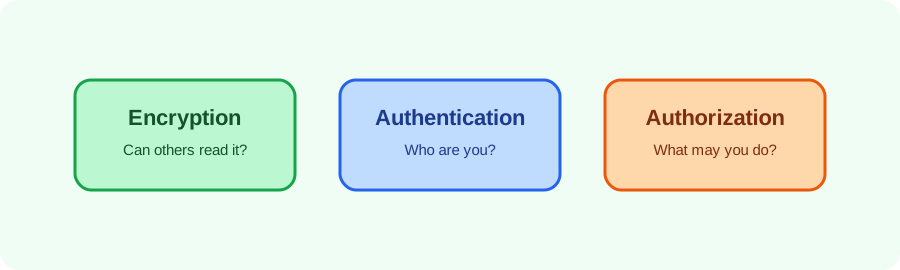
While working with infrastructure, security controls feel very concrete: a certificate expires, a broker needs authorization, or an account has too much access. Studying CISM helped me connect those individual tasks to the larger management context.
Governance comes first#
Governance connects security work to business objectives. A control is stronger when its purpose is explicit:
Business objective -> risk -> control -> owner -> evidence -> reviewFor example, protecting Kafka traffic may support confidentiality requirements for customer events. The control might be TLS with managed certificate rotation. The owner is the platform team, and the evidence could include configuration review, certificate inventory, and a rotation test.
Risk is not a checklist#
A risk statement should describe an uncertain event, its cause, and its impact. “Kafka is insecure” is too vague to guide a decision. A better statement might be: “If an unauthorized application obtains broker credentials, it could read sensitive event streams, causing disclosure and regulatory impact.”
That statement supports decisions about authentication, authorization, monitoring, and credential revocation.
Controls need owners and evidence#
A policy without an owner is a wish. For each important control, identify:
- who operates it;
- how often it is reviewed;
- what evidence demonstrates operation;
- what happens when it fails;
- which risk it reduces.
Automation helps create evidence, but an exported report is not proof by itself. The organization still needs to know whether the control was correctly designed and whether exceptions are approved.
Incident management#
Incident response is more than reacting quickly. It includes preparation, detection, response, and recovery. For a suspected broker credential compromise, preparation might include separate identities and tested rotation. Detection might be an unusual authorization pattern. Response could revoke the identity and isolate the affected broker. Recovery includes restoring service and learning from the event.
The technical runbook and the management process should agree on severity, ownership, communication, and decision authority.
A useful study habit#
For each technical topic, ask:
- What business asset is being protected?
- What is the threat and likely impact?
- Which control reduces the risk?
- Who owns the control?
- How is effectiveness measured?
- What happens when the control fails?
This makes certification study more useful at work. It also prevents security from becoming a collection of disconnected tools. Good security management translates technical detail into accountable decisions.
Illustrative risk-register entry:
Risk ID: INFRA-014
Likelihood: Possible
Impact: High
Owner: Platform Engineering
Treatment: Reduce
Review: Quarterly