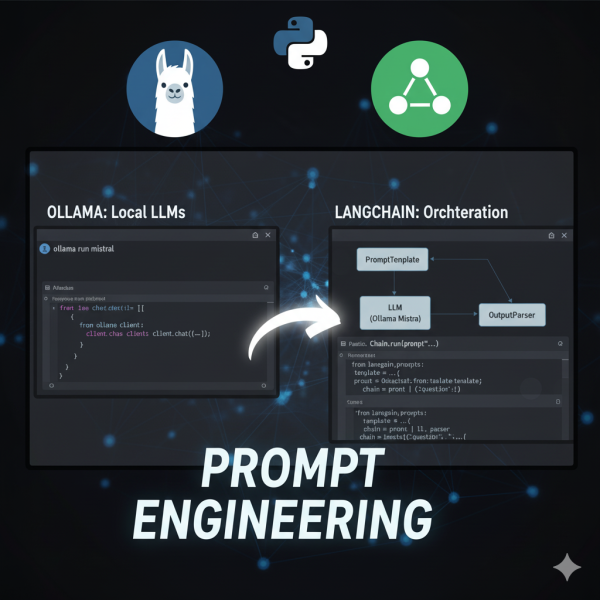
This post walks through a tiny, practical example that uses LangChain primitives and a local Ollama server to run a prompt-based summarization. The project is intentionally small so you can learn the core ideas quickly: extracting prompts, initializing an LLM client, composing a chain, and running it locally.
Repository used in this post: llangchain-tutorialllangchain-tutorial
What you’ll learn#
- How to separate prompts from code for rapid iteration.
- How to initialize and call a local
Ollamaserver from Python usingChatOllama. - The basics of composing a LangChain chain: PromptTemplate | LLM.
- How to structure code for clarity and reusability.
Why use a local runtime (Ollama)?#
Local runtimes like Ollama let you iterate quickly without network latency and without sending data to a cloud provider — useful for testing, privacy, and cost control. In this demo we use Ollama as the model host and ChatOllama from the langchain_ollama integration to talk to it.
Project walkthrough#
Files we care about:
main.py— entrypoint and orchestratorprompts/summary_template.txt— extracted prompt templateREADME.md— run instructions and a Mermaid flowchart
Core idea#
main.py follows a simple pattern:
- Load environment variables (
OLLAMA_HOST,OLLAMA_PORT). - Load a prompt template from
prompts/summary_template.txt. - Initialize a
ChatOllamaclient using the host and port. - Build a chain by composing a PromptTemplate with the LLM (
PromptTemplate(...) | llm). - Invoke the chain with
chain.invoke(input={"information": information})and print the response.
Keeping the prompt in a file makes it easy for non-developers to tweak the prompt text without touching code. The helper functions in main.py (load_prompt, init_ollama_llm, build_chain) make each step testable and reusable.
Prompt template#
The prompt is intentionally simple and lives in prompts/summary_template.txt:
Given the information {information}, about the person I want you to create:
    1. A short summary
    2. Two interesting facts about them.
Key snippet: building and invoking the chain#
# load prompt
prompt_text = load_prompt("prompts/summary_template.txt")

# init llm
llm = init_ollama_llm()

# compose chain
chain = build_chain(prompt_text, ["information"], llm)

# invoke
response = chain.invoke(input={"information": information})
print(response.content)
Note: The keys in the input dict must match the input_variables declared when creating the PromptTemplate. Passing a different key (e.g., "info") without updating the template will raise a missing-variable error.
How to run the demo#
- Copy the env example and edit if necessary:
cp .env.example .env- Create a virtual environment and install dependencies:
python -m venv .venv
source .venv/bin/activate
pip install -r requirements.txt- Ensure Ollama is running and reachable (default:
localhost:11434). You can check:
curl http://localhost:11434/api/models
curl http://localhost:11434/api/tags- Run the example:
python main.pyYou should see a short printed summary and two facts derived from the information sample in the repo.
Common pitfalls and debugging#
- Prompt variable mismatch: ensure the dict keys you pass to
chain.invokematch the PromptTemplate’sinput_variables. - Ollama connectivity: if the server isn’t running,
curlthe endpoints above and verify the host/port.
Next steps and experiments#
- Add memory to the chain to keep conversation context across invocations.
- Swap
ChatOllamafor another provider (OpenAI, Anthropic) to compare behavior. - Add unit tests: validate
load_promptand use a mocked LLM to ensure the prompt is formatted correctly. - Create a small web UI to let users paste text and see summarization results.
Conclusion#
This project shows how to structure a small LangChain-based demo that talks to a local LLM runtime. The key takeaways are: keep prompts separate, build small reusable helpers, and use local runtimes for fast iteration.