This series picks up where my earlier posts left off. Those covered the ideas: what generative AI is, how transformers pay attention, why GPUs matter, and two hands-on builds (LangChain with Ollama and a RAG assistant). This part is the map that connects them.
The stack, bottom to top#
| Layer | What it does | Names you’ll meet |
|---|---|---|
| Hardware | Does the arithmetic: mostly matrix multiplication | GPUs (CUDA), TPUs, Apple silicon |
| Tensor frameworks | Tensors, automatic gradients, training loops | PyTorch, TensorFlow/Keras, JAX |
| Classic ML | Models that aren’t neural networks, and the data work around them | scikit-learn, pandas, PySpark |
| Model libraries | Ready-made architectures and pretrained weights | Hugging Face Transformers, Datasets, Tokenizers, PEFT |
| Serving / runtimes | Run a trained model and answer requests | Ollama, llama.cpp, vLLM, managed APIs |
| Orchestration | Chain prompts, retrieval and tools into an application | LangChain/LangGraph, LlamaIndex |
| Retrieval | Store embeddings and find similar text | Chroma, FAISS, pgvector |
| MLOps / platforms | Pipelines, tracking, registries, deployment | MLflow, Kubeflow, Vertex AI |
Most confusion comes from comparing tools on different rows. “LangChain or PyTorch?” is like asking “Flask or the Linux kernel?”: you will often use both, at different layers.
Tensor frameworks: where models are built#
PyTorch is the default for research and for most open-weight language models. Code reads like ordinary Python, and debugging works the way you expect. TensorFlow with Keras remains common in older production systems; Keras 3 can also run on top of PyTorch or JAX. JAX is NumPy with automatic differentiation and a compiler, popular in research and on Google’s TPUs.
If you are not training or fine-tuning models yourself, you may never write code at this layer, but it is underneath everything above it.
Classic ML: still the right tool surprisingly often#
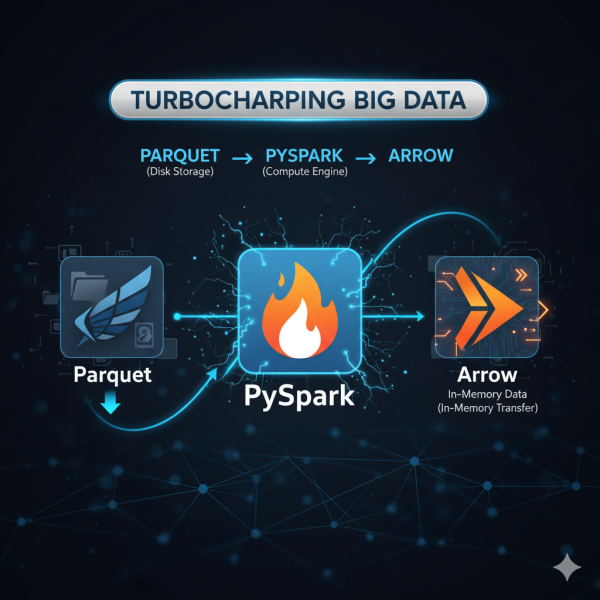
Not every problem needs a neural network. K-nearest neighbours, linear regression, TF-IDF and forecasting models live in scikit-learn and friends. They train in seconds, explain themselves, and run anywhere. Data preparation sits here too: pandas on one machine, PySpark when the data outgrows it (I compared the two here).
Model libraries: standing on shoulders#
Hugging Face Transformers gives you thousands of pretrained models behind a common interface: download a model, tokenize text, run it. Datasets and Tokenizers handle the data side, and PEFT makes fine-tuning affordable by training small adapter layers instead of the whole model.
Serving: making a model answer#
Two very different options:
- Run it yourself. Ollama and llama.cpp make local models easy on a laptop; vLLM serves them efficiently to many users on GPU servers. You pay for hardware, not per token, and your data never leaves your machine.
- Call a managed API. Hosted models (Claude, GPT, Gemini and others) are the most capable and need no hardware, but you pay per token. Part 3 is about exactly that bill.
Orchestration and retrieval: from model to application#
A model alone just completes text. Applications need prompts kept in files, retrieved documents, memory, tools and error handling. LangChain (and LangGraph for multi-step flows) and LlamaIndex (strongest on document retrieval) provide those pieces. Vector stores such as Chroma, FAISS or pgvector hold embeddings so you can find the passages relevant to a question: the “R” in RAG.
A word of caution from building with them: these frameworks change quickly. Keep your own code thin around them, and pin versions.
MLOps: making it repeatable#
Once a model matters, you need to know which data and code produced it, and to rebuild it on demand. MLflow tracks experiments and models; Kubeflow Pipelines describes training as a graph of steps; cloud platforms such as Vertex AI run those pipelines for you. Part 2 walks through one.
Picking, in one table#
| You want to… | Start with |
|---|---|
| Classify, cluster or forecast tabular data | scikit-learn (+ pandas or PySpark) |
| Use a pretrained language or vision model | Hugging Face Transformers |
| Train or fine-tune a neural network | PyTorch (+ PEFT for fine-tuning) |
| Chat with a model privately on your laptop | Ollama |
| Build a chatbot over your own documents | LangChain or LlamaIndex + a vector store |
| Give a model access to tools and data | MCP (part 5) |
| Retrain and deploy on a schedule | Kubeflow Pipelines / Vertex AI Pipelines + a model registry |
Takeaways#
- Name the layer before you compare tools. Most “X vs Y” debates compare different rows of the stack.
- Prefer boring tools where they fit. scikit-learn beats a neural network on many small, tabular problems.
- Keep framework glue thin. The model and your data last longer than any orchestration library’s API.
Further reading#
- PyTorch · scikit-learn · Hugging Face Transformers
- The whole AI shelf on this site: AI on this blog: a reading map
Next: part 2, ML pipelines on Google Vertex AI.